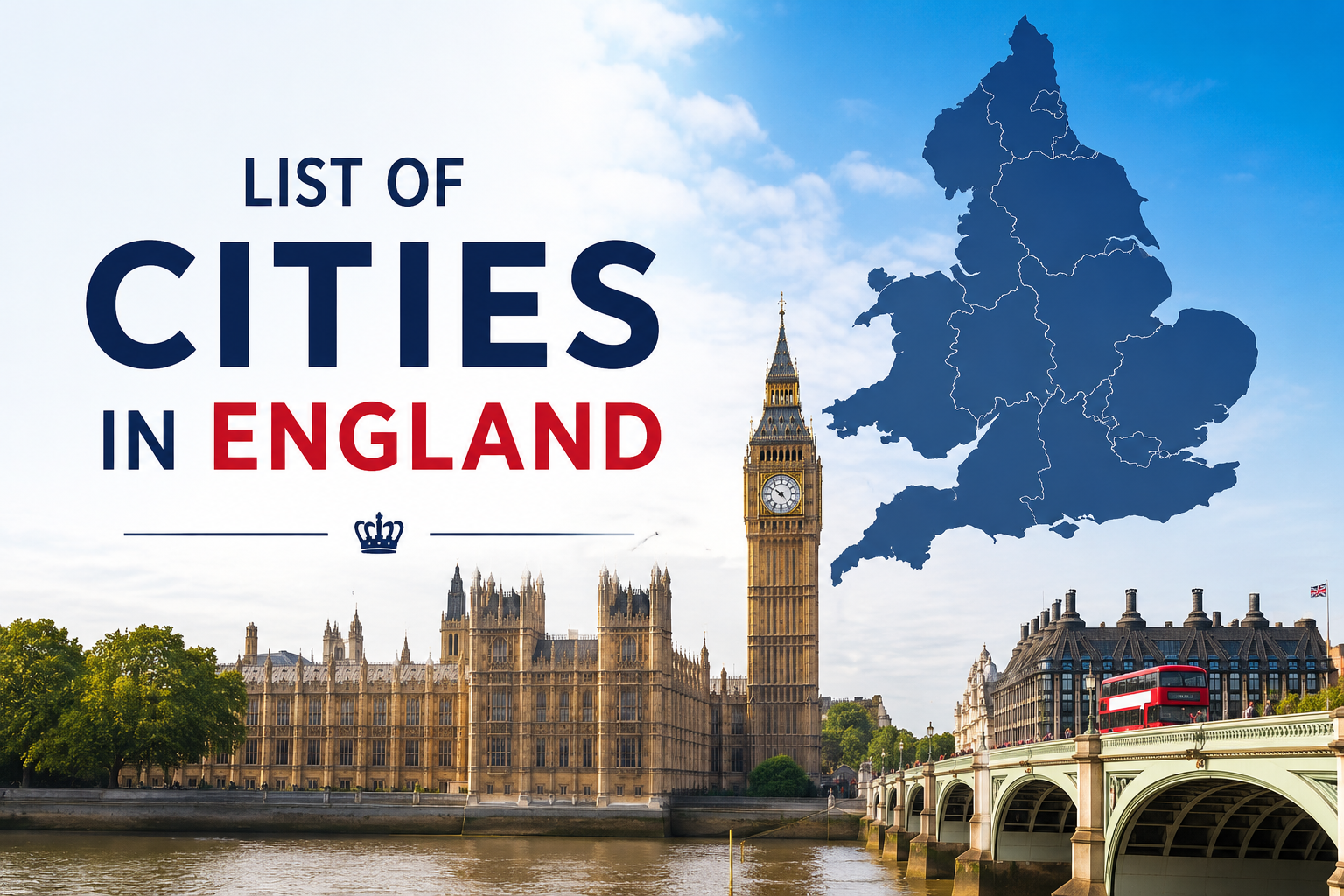
Did you know that not all big towns in England are cities? England has many interesting cities, each with its own identity and history. Some cities are large and busy, while others are small and peaceful.
List Of Cities in England helps you understand these differences in a simple way. England has 55 officially recognised cities, and each one varies in size, population, and local governance.
Some cities are very old with deep historical roots, while others are modern and growing quickly. This list makes it easy to learn about England’s cities clearly and simply, whether you are a student, traveller, or just curious to know more.
List of Cities in England
England has 55 official cities. Here is the each city’s population, area size, and local council:
| No. | City | Approx. Population | Area (km²) | City Council |
| 1 | Bath | ~94,000 | 29 | Bath & North East Somerset Council |
| 2 | Birmingham | ~1,145,000 | 267 | Birmingham City Council |
| 3 | Bradford | ~550,000 | 370 | Bradford Metropolitan District Council |
| 4 | Brighton and Hove | ~290,000 | 82 | Brighton & Hove City Council |
| 5 | Bristol | ~472,000 | 110 | Bristol City Council |
| 6 | Cambridge | ~145,000 | 40 | Cambridge City Council |
| 7 | Canterbury | ~165,000 | 124 | Canterbury City Council |
| 8 | Carlisle | ~108,000 | 1,039 | Cumberland Council |
| 9 | Chelmsford | ~180,000 | 342 | Chelmsford City Council |
| 10 | Chester | ~120,000 | 91 | Cheshire West & Chester Council |
| 11 | Chichester | ~27,000 | 15 | Chichester District Council |
| 12 | Colchester | ~185,000 | 333 | Colchester City Council |
| 13 | Coventry | ~360,000 | 99 | Coventry City Council |
| 14 | Derby | ~260,000 | 78 | Derby City Council |
| 15 | Doncaster | ~310,000 | 568 | Doncaster Metropolitan Borough Council |
| 16 | Durham | ~50,000 | 9 | Durham County Council |
| 17 | Ely | ~20,000 | 24 | East Cambridgeshire District Council |
| 18 | Exeter | ~135,000 | 47 | Exeter City Council |
| 19 | Gloucester | ~130,000 | 40 | Gloucester City Council |
| 20 | Hereford | ~63,000 | 12 | Herefordshire Council |
| 21 | Kingston upon Hull | ~260,000 | 71 | Hull City Council |
| 22 | Lancaster | ~145,000 | 576 | Lancaster City Council |
| 23 | Leeds | ~812,000 | 551 | Leeds City Council |
| 24 | Leicester | ~370,000 | 73 | Leicester City Council |
| 25 | Lichfield | ~35,000 | 26 | Lichfield District Council |
| 26 | Lincoln | ~100,000 | 35 | City of Lincoln Council |
| 27 | Liverpool | ~498,000 | 112 | Liverpool City Council |
| 28 | London | ~8,980,000 | 1,572 | Greater London Authority |
| 29 | Manchester | ~553,000 | 115 | Manchester City Council |
| 30 | Milton Keynes | ~287,000 | 309 | Milton Keynes City Council |
| 31 | Newcastle upon Tyne | ~300,000 | 113 | Newcastle City Council |
| 32 | Norwich | ~145,000 | 39 | Norwich City Council |
| 33 | Nottingham | ~330,000 | 75 | Nottingham City Council |
| 34 | Oxford | ~155,000 | 46 | Oxford City Council |
| 35 | Peterborough | ~215,000 | 343 | Peterborough City Council |
| 36 | Plymouth | ~265,000 | 80 | Plymouth City Council |
| 37 | Portsmouth | ~208,000 | 40 | Portsmouth City Council |
| 38 | Preston | ~145,000 | 142 | Preston City Council |
| 39 | Ripon | ~17,000 | 8 | Harrogate Borough Council |
| 40 | Salford | ~270,000 | 97 | Salford City Council |
| 41 | Sheffield | ~585,000 | 368 | Sheffield City Council |
| 42 | Southampton | ~255,000 | 72 | Southampton City Council |
| 43 | St Albans | ~85,000 | 161 | St Albans City & District Council |
| 44 | Stoke-on-Trent | ~255,000 | 93 | Stoke-on-Trent City Council |
| 45 | Sunderland | ~275,000 | 137 | Sunderland City Council |
| 46 | Truro | ~23,000 | 14 | Cornwall Council |
| 47 | Wakefield | ~345,000 | 338 | Wakefield Council |
| 48 | Wells | ~12,000 | 6 | Somerset Council |
| 49 | Westminster | ~255,000 | 21 | Westminster City Council |
| 50 | Winchester | ~125,000 | 666 | Winchester City Council |
| 51 | Wolverhampton | ~265,000 | 69 | Wolverhampton City Council |
| 52 | Worcester | ~103,000 | 39 | Worcester City Council |
| 53 | York | ~215,000 | 272 | City of York Council |
| 54 | Southend-on-Sea | ~180,000 | 42 | Southend-on-Sea City Council |
| 55 | Milton Keynes | ~287,000 | 309 | Milton Keynes City Council |
Note:The information given for each city may differ based on the source and can change over time. This list is meant for general reference and includes some of the most popular cities in England.
1. Bath
Bath is one of England’s most beautiful and historic cities. Located in Somerset, Bath is globally famous for its natural hot springs, Roman Baths, and Georgian architecture. The entire city is recognised as a UNESCO World Heritage Site, which already tells you how special it is.
Bath isn’t a noisy, fast-paced city. Instead, it offers a calm, elegant atmosphere where history blends perfectly with modern lifestyle. Walking through Bath feels like stepping back into Roman and Georgian times.
What Makes Bath Special?
- Only city in England with natural hot springs
- Home to the Roman Baths, over 2,000 years old
- Entire city is a UNESCO World Heritage Site
- Popular for wellness, culture, and architecture
| Detail | Information |
| County | Somerset |
| Population | ~94,000 |
| City Status | Granted in ancient times |
| UNESCO Status | Yes |
| Famous For | Roman Baths, Georgian architecture |
Key Attractions
- Roman Baths
- Bath Abbey
- Royal Crescent
- Thermae Bath Spa
2. Birmingham
Birmingham is England’s second-largest city and one of the most important economic centres in the UK. Located in the West Midlands, it played a huge role during the Industrial Revolution, earning it the nickname “Workshop of the World.”
Today, Birmingham is modern, diverse, and fast-growing. It has more canals than Venice and is known for business, education, shopping, and cultural diversity.
What Makes Birmingham Special?
- Second-largest city in England
- Major business and financial hub
- One of the UK’s most multicultural cities
- Excellent transport and connectivity
| Detail | Information |
| Region | West Midlands |
| Population | ~1.14 million |
| Rank by Population | 2nd in England |
| Famous For | Industry, canals, shopping |
| Economy | One of UK’s strongest city economies |
Key Attractions
- Bullring & Grand Central
- Cadbury World
- Birmingham Museum & Art Gallery
- Library of Birmingham
3. Bradford
Bradford is a historic city in West Yorkshire, known for its Victorian architecture, film heritage, and cultural diversity. It became the world’s first UNESCO City of Film, making it unique not just in England but globally.
Bradford also has strong industrial roots, especially in textiles, and today it stands as a city of culture, education, and community values.
What Makes Bradford Special?
- World’s first UNESCO City of Film
- Strong Victorian and industrial heritage
- Recognised as an International City of Peace
- Rich cultural diversity
| Detail | Information |
| Region | West Yorkshire |
| Population | ~550,000 |
| UNESCO Title | City of Film |
| Known For | Film, textiles, culture |
| Peace Status | International City of Peace |
Key Attractions
- National Science and Media Museum
- Saltaire Village
- Bradford City Park
4. Brighton and Hove
Brighton and Hove is a lively seaside city on England’s south coast. Known for its beach, pier, creativity, and inclusive culture, it’s one of the UK’s most popular tourist cities.
The city beautifully combines historic Regency architecture with modern lifestyle and nightlife. It is also widely recognised as one of the most LGBTQ+ friendly cities in the UK.
What Makes Brighton and Hove Special?
- Popular seaside destination
- Famous for arts, music, and festivals
- Strong creative and digital economy
- Highly inclusive and diverse community
| Detail | Information |
| County | East Sussex |
| Population | ~290,000 |
| City Type | Coastal |
| Famous For | Beach, pier, culture |
| Lifestyle | Creative & inclusive |
Key Attractions
- Brighton Pier
- Royal Pavilion
- Brighton Beach
- The Lanes
5. Bristol
Bristol is one of the most creative and forward-thinking cities in England. Located in the South West, it has a rich maritime history and is famous for innovation, street art, and music.
Bristol consistently ranks among the best cities to live in the UK, thanks to its quality of life, green initiatives, and cultural scene.
What Makes Bristol Special?
- Strong maritime and trading history
- Birthplace of famous street art culture
- Green and sustainable city
- Thriving creative industries
| Detail | Information |
| Region | South West England |
| Population | ~470,000 |
| Known For | Art, music, harbour |
| Sustainability | One of UK’s greenest cities |
| Economy | Strong creative sector |
Key Attractions
- Bristol Harbour
- Clifton Suspension Bridge
- SS Great Britain
- Street Art Trails
Conclusion
England has 55 official cities, and this List Of Cities in England shows how different each city is. Some cities are very big and busy, like London and Birmingham, while others are small and quiet, like Wells and Ripon.
Every city has its own population size, area, and local council. Together, this List Of Cities in England helps us understand England’s history, culture, and growth in a simple way. It is useful for students, travellers, and anyone who wants easy information about cities in England.
Frequently Asked Questions
How many cities are in England?
England has 55 officially recognised cities, as granted by the British Monarch through city status.
What is England’s smallest city?
Wells is considered England’s smallest city by population, with around 12,000 residents.
What is England’s second biggest city?
Birmingham is England’s second biggest city by population, after London.
What is the least populated part of England?
Rural areas such as parts of Northumberland and Cumbria are among the least populated parts of England.
What is the most empty part of England?
The Northumberland National Park area is considered one of the most empty and sparsely populated parts of England.